Products ISO 16673
Visual occlusion goggles
Liquid crystal goggles for measuring the visual demand of in-vehicle tasks with the occlusion method of ISO 16673:2017 and the NHTSA visual-manual driver distraction guidelines.
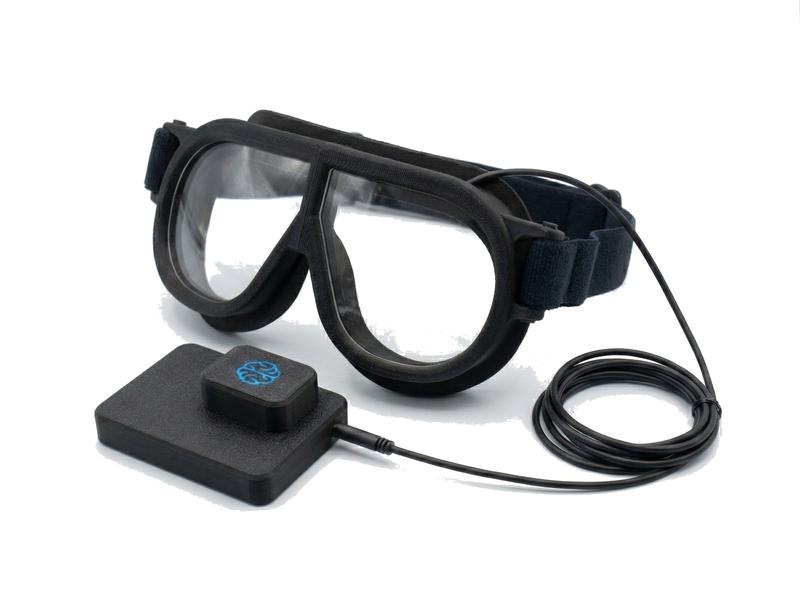 Fig. 1 Occlusion cycle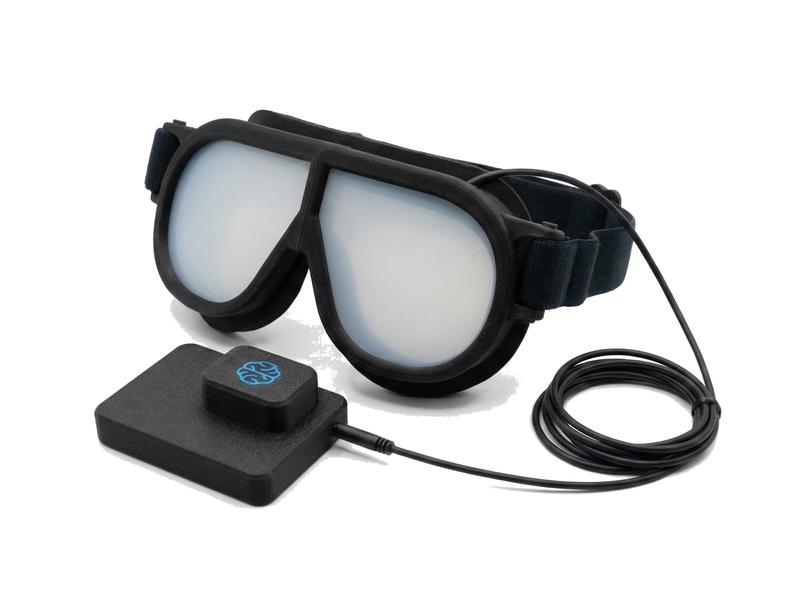
- <10ms
- Opening transition
- ~50ms
- Closing, to functional occlusion
- 1ms
- Timing resolution, on the controller
- 2yr
- Warranty
Method
In an occlusion test the participant works through a task on an in-vehicle interface while the lenses alternate between clear and opaque, 1.5 s each by default. The opaque intervals stand in for glances back to the road. The participant may keep operating the controls while the lenses are closed but can see neither the display nor the controls.
The test yields three measures, as ISO 16673 defines them:
- Total shutter open time (TSOT)
- The sum of the open intervals the participant needs to complete the task.
- Total task time unoccluded (TTTUnoccl)
- The time to complete the same task with normal vision and no concurrent task.
- Resumability ratio (R)
- TSOT divided by TTTUnoccl. It indexes how readily the participant resumes the task after each interruption.
The NHTSA guidelines accept a task when at least 21 of 24 participants complete it with no more than 12 s of total shutter open time.
Specifications
| Lenses | Polymer-dispersed liquid crystal (PDLC) |
|---|---|
| Opening transition | Under 10 ms, opaque to clear |
| Closing transition | About 50 ms to functional occlusion, about 100 ms to full opacity |
| Interval and TSOT timing | The controller times the intervals and accumulates TSOT itself, on a 1 ms clock. The host computer's timing does not affect either |
| Presets | NHTSA cycle, peek, direct control, custom |
| Control | USB serial. RSLogger, or open and close commands from your own software |
| Output | CSV with one row per trial: TSOT and total shutter closed time |
| Warranty | Two years |
Kit contents
- One pair of occlusion goggles with liquid crystal lenses
- One controller box
- Two participant response buttons
Software
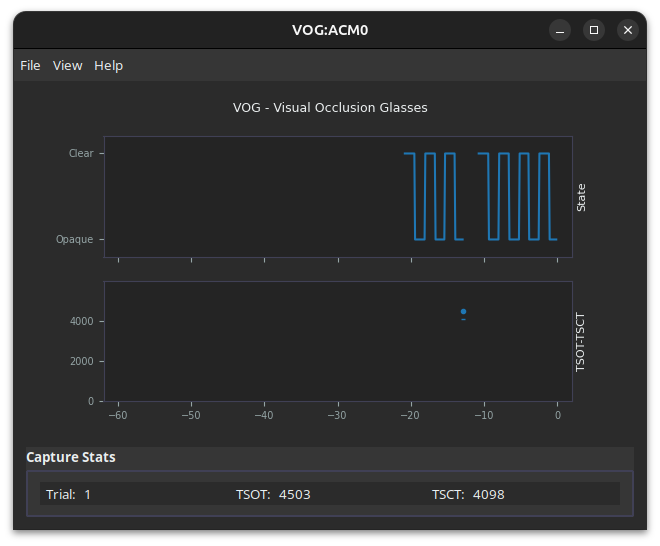
The goggles run from RSLogger, which is included. Its VOG module sets the open and closed intervals and records the TSOT that the controller reports for each trial. The participant’s response button can start and stop the trial. RSLogger stamps each row with the same host clock it uses for cameras, the eye tracker and the DRT recorded in the same session.
References
- ISO. (2017). ISO 16673:2017 Road vehicles — Ergonomic aspects of transport information and control systems — Occlusion method to assess visual demand due to the use of in-vehicle systems. International Organization for Standardization.
- NHTSA. (2013). Visual-Manual NHTSA Driver Distraction Guidelines for In-Vehicle Electronic Devices. 78 FR 24817. National Highway Traffic Safety Administration.
- JAMA. (2004). Guidelines for In-vehicle Display Systems — Version 3.0. Japan Automobile Manufacturers Association.
- SAE International. (2015). SAE J2364: Navigation and Route Guidance Function Accessibility While Driving.
- Alliance of Automobile Manufacturers. (2006). Statement of Principles, Criteria and Verification Procedures on Driver Interactions with Advanced In-Vehicle Information and Communication Systems.
Ordering
Order the goggle kit
The complete kit carries a two-year warranty, and we ship worldwide. Tell us about your protocol and we will reply with a formal quote, usually within one business day.