Research and engineering
We design and run studies of drivers, instrument vehicles, and build the hardware and software a study needs. The work runs on the road, on the test track and in the simulator, with the same instruments we sell.
Capabilities
Studies with people
We design and run studies in the laboratory, the driving simulator, on the road and on test tracks: protocols, IRB approval, federal information-collection clearance, participant management and reporting.
Vehicle instrumentation
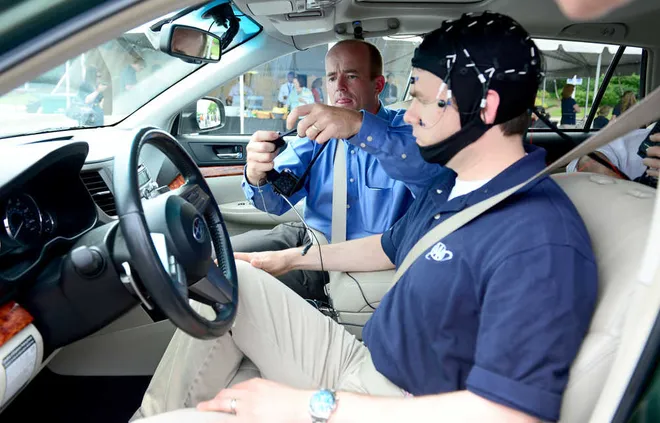
We instrument participants’ own vehicles for naturalistic studies (see past projects) and keep an instrumented 2021 Toyota Tacoma as a test vehicle. Kits combine several cameras, eye tracking with the Pupil Labs Neon, GPS and inertial sensors, and data from the vehicle network.
Human factors evaluation
We measure the visual, manual and cognitive demand of touchscreens, voice interfaces and portable devices with the ISO 16673 and ISO 17488 methods, and compare the results with the criteria in the NHTSA guidelines (Strayer et al., 2019a; Cooper et al., 2020). With David Strayer’s laboratory at the University of Utah and the AAA Foundation for Traffic Safety, Joel Cooper helped develop a rating scale for cognitive distraction and applied it to voice assistants, smartphones and infotainment systems (Strayer et al., 2015; Strayer et al., 2019b).
Instruments and electronics
We design, build and support our own instruments, the occlusion goggles and the detection response task, in wired and wireless versions: circuit boards, firmware, enclosures, in-house assembly, 3D printing and laser cutting.
Software and data
RSLogger, the free acquisition software that ships with our instruments, records every stream in a session against one host clock. We take the analysis from raw recordings to the report: eye tracking mapped to the cockpit, coding of driver behavior from video, and statistical models.
Lighting and visibility
We measure road and scene lighting and judge what a driver can see at night: illuminance surveys, calibrated contrast photographs and visibility analysis. Current work includes a project on vehicle signal lamps.
Past projects
Completed work only. Joel Cooper’s research has been funded with him as a principal or co-principal investigator, as a subcontractor and as university research staff. Collaborating institutions include the University of Utah, the University of Newcastle and the Texas A&M Transportation Institute.
Red Scientific contracts
| Project | Sponsor and role | Years |
|---|---|---|
| Level 2 automation, hybrid naturalistic study Instrumented the participants’ own vehicles, reduced the video, analyzed the data and wrote the naturalistic report (Cooper et al., 2023). | AAA Foundation for Traffic Safety, by subaward from the University of Utah | 2019–2021 |
| DRT test data and procedure update Analyzed detection response task test data and updated the test procedures. | VicRoads, Australia | 2020 |
| Distraction from in-vehicle interfaces Scientific adviser to the University of Newcastle team that ran the study: design, analysis and review of the report. | Australian Automobile Association · principal investigator | 2022–2025 |
| Driving simulator relocation Took apart, moved and reassembled a driving simulator, with a subcontracted engineer. | Westat | 2025 |
Earlier, on university teams and as a consultant
| Project | Sponsor and role | Years |
|---|---|---|
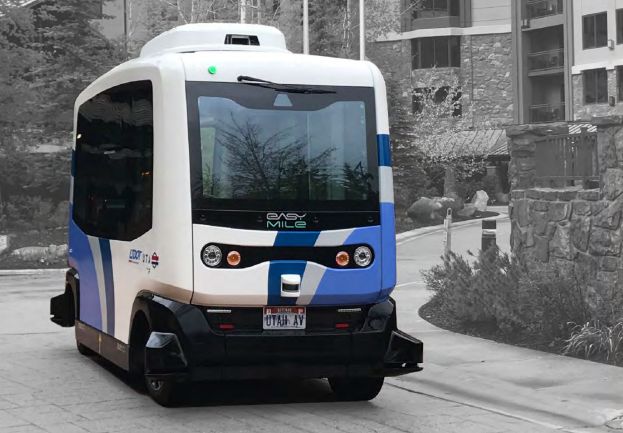
| Rider trust in an automated shuttle Rider surveys and interviews on the campus shuttle (Carriero et al., 2020). | Utah Department of Transportation · principal investigator, University of Utah | 2020 |
| Cognitive distraction and infotainment series, phases 1 to 6 and the age study | AAA Foundation for Traffic Safety · co-principal investigator, University of Utah | 2011–2019 |
| Distraction test procedures for connected-vehicle systems; mobile device integration | NHTSA · research staff, University of Utah | 2010–2013 |
| Crash warning interface metrics, phase 3 | NHTSA, through Westat · consultant | 2012–2013 |
| Reducing roadway departure crashes at horizontal curves | FHWA · co-investigator | 2012–2014 |
Working with us
Prime, subcontract or consulting
We take on contract studies as a prime contractor or within a larger program, and we instrument vehicles, build hardware and reduce data for studies that other teams run.